
Short answer: Binance VIP levels are account tiers that can change maker and taker fees and may provide other service benefits. Qualification is not based on one universal number: the current program can consider trading activity, asset holdings, borrowing or other defined paths. Product-specific rates and your signed-in Binance fee page remain the final sources for what applies to your account.
Last verified: August 16, 2026. VIP pathways, thresholds, benefits and rates can change. This guide explains the structure without copying a fee table that could become stale.
Binance VIP levels at a glance
| Item | What to verify |
|---|---|
| Current VIP level | The level displayed in the signed-in account or fee dashboard. |
| Qualification path | The live requirements for trading, holding, borrowing or another eligible route. |
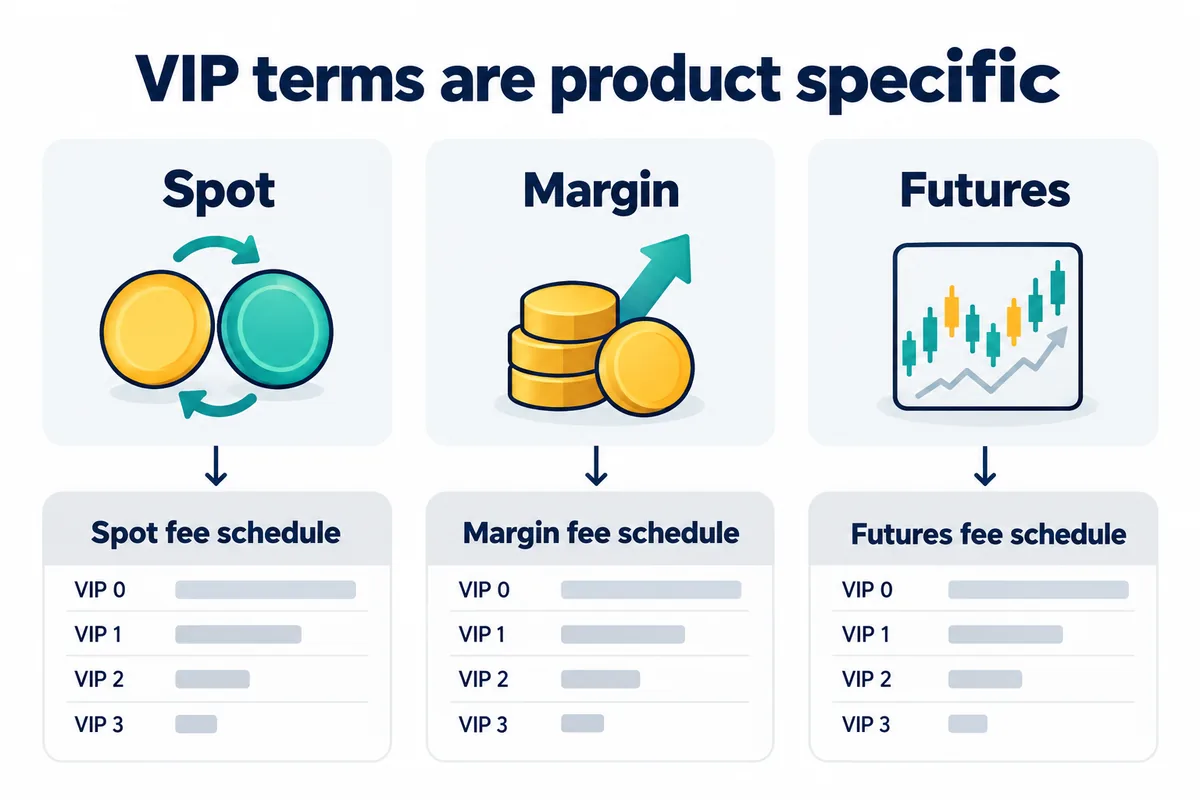
| Product | Spot, Margin, USDⓈ-M Futures, COIN-M Futures and Options can use separate schedules. |
| Execution role | Maker and taker rates can differ within the same tier. |
| Additional reduction | BNB fee payment, pair promotions or another program may have separate rules. |
| Review timing | The account page should show the current assessment and effective tier. |
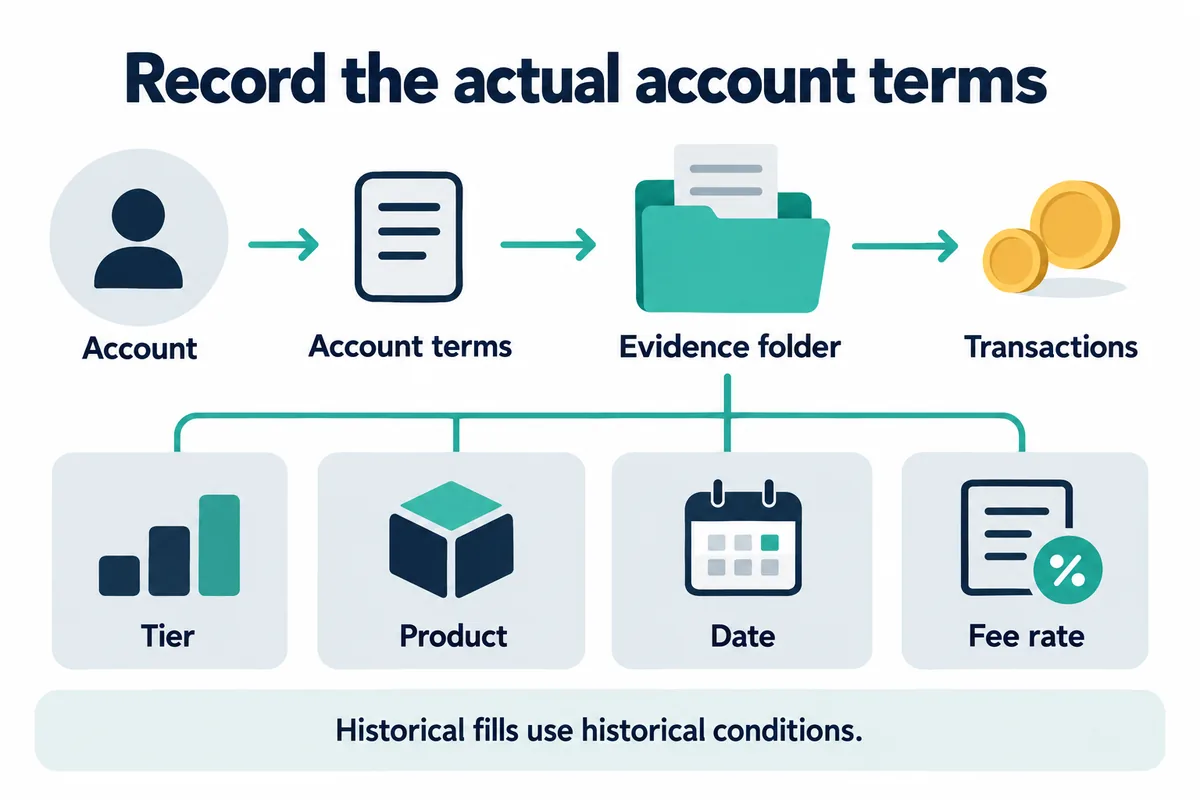
Bimence explanatory diagrams, not official account screens. Product and account conditions apply.
What a Binance VIP level can change
The most visible VIP effect is a tiered fee schedule. Higher eligible levels may receive different maker and taker rates. Binance also describes service benefits for qualifying users, but availability may vary by program, jurisdiction and account type.
A VIP label should not be interpreted as a universal fee. First identify the product. A Spot maker rate cannot be assumed to apply to Futures, Margin, Options, P2P or a wallet service. Then check whether the order acted as a maker or taker. Our Binance maker vs taker guide explains that distinction.
How qualification works
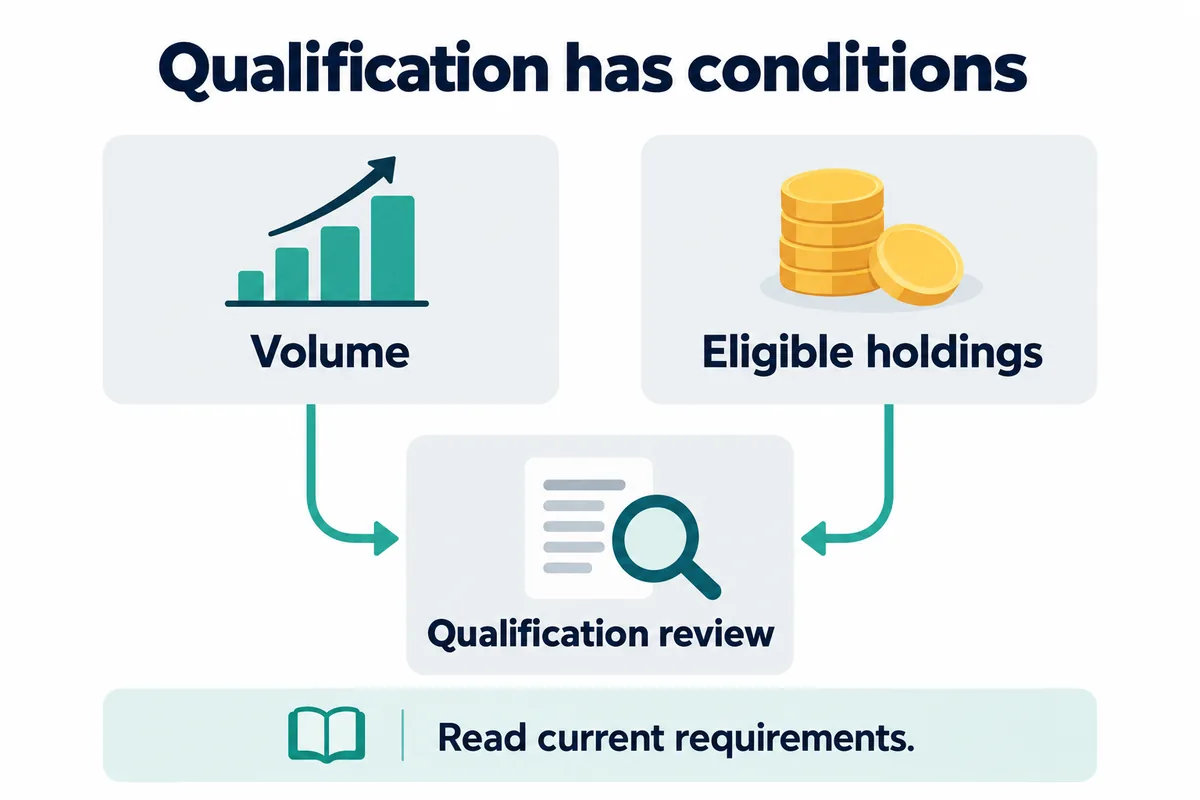
Binance can provide more than one route to a VIP level. Depending on the current program, qualification may involve trading volume, asset or BNB holdings, borrowing activity or another published criterion. The thresholds and measurement periods can change, so a static table copied into a third-party article is not a reliable account decision tool.
Use this verification sequence:
- Sign in directly at Binance and open the VIP or fee dashboard.
- Identify the qualification path associated with the displayed level.
- Confirm the measurement window and the asset or product included in the calculation.
- Check when Binance reviews the account and when a new level becomes effective.
- Open the fee schedule for the exact product you intend to use.
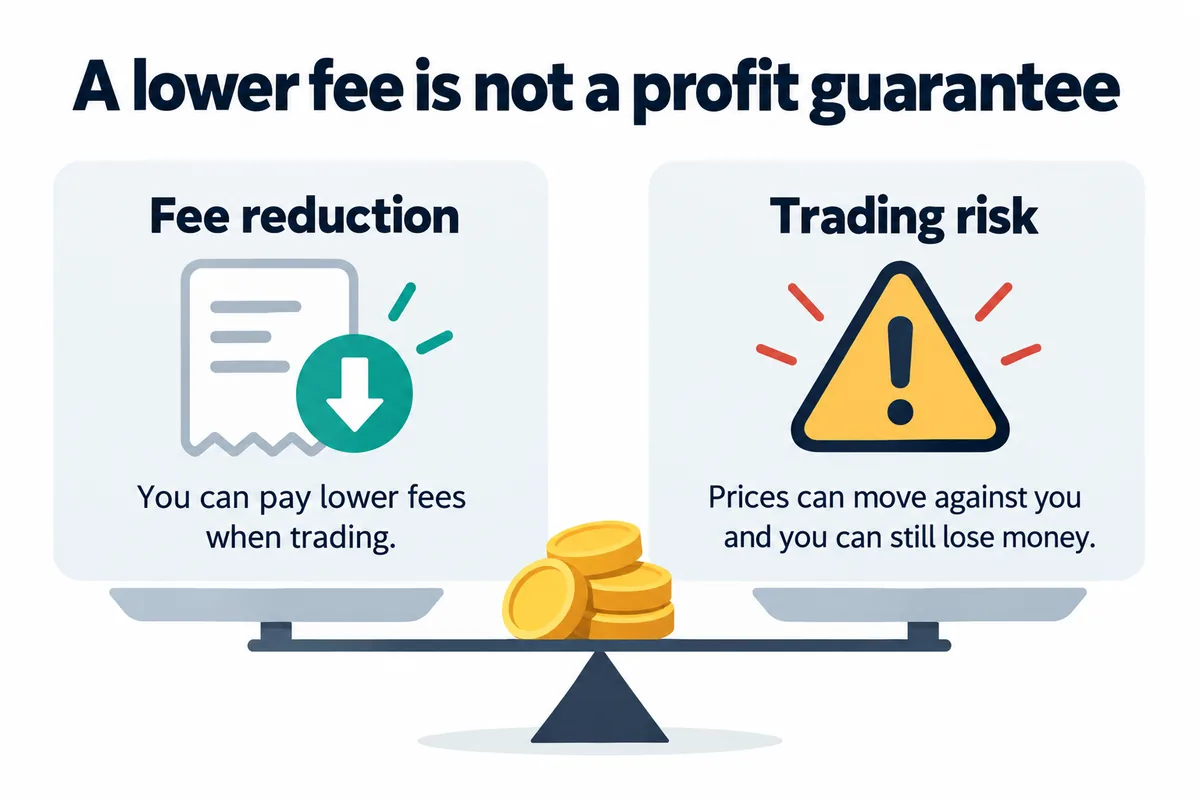
Do not move assets, increase borrowing or trade solely to reach a tier without calculating the additional market, financing and operational risks. A lower displayed rate does not automatically offset the cost of extra activity.
VIP fee tiers are product-specific
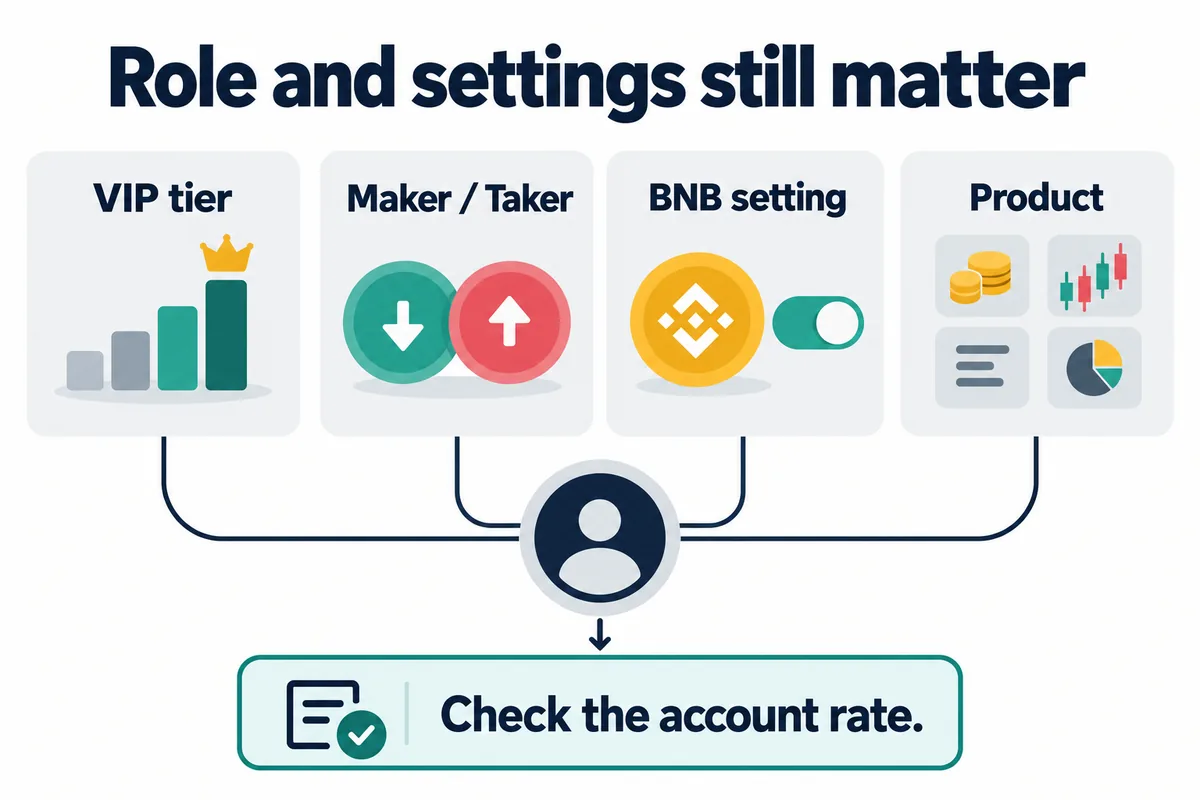
Binance publishes separate fee schedules because its products have different market structures. When estimating a fee, record all four inputs:
- Product: the market or service being used;
- VIP level: the currently effective account tier;
- Order role: maker or taker;
- Additional condition: BNB payment, a pair promotion or another eligible reduction.
The educational calculation remains straightforward:
Estimated trading fee = executed trade value × the applicable account rate
If the signed-in page shows a hypothetical applicable rate of 0.08% and the executed value is 10,000 USDT, the simple estimate is 8 USDT. This example does not state that 0.08% is a current Binance rate for any particular tier or product.
How BNB fee payment fits with VIP
VIP tiering and paying eligible fees with BNB are separate concepts. The VIP level can determine the underlying account rate, while an eligible BNB fee-payment reduction may affect what is charged after the required setting and balance conditions are met. Product rules and promotions control whether and how reductions combine.
Do not add percentages as if every discount applies independently. For example, “20% plus 25% equals 45% off” can be mathematically and contractually misleading. Read the Binance BNB fee discount guide and verify the final rate displayed by Binance.
Is it worth trying to reach a higher level?
Start with break-even analysis rather than the tier name. Estimate the fee difference on activity you already expect to perform. Then compare it with the cost and risk of any extra trading, asset holding or borrowing needed to qualify.
Same activity, different hypothetical rates
Bimence worked example: simplified Spot trading fees, with the same USD-denominated executed value in both scenarios: 60,000 USD maker and 40,000 USD taker. A and B are fictional final rates, not current Binance VIP tiers or qualification requirements. USD is an illustrative valuation unit, not the actual commission asset.
| Execution | A | B |
|---|---|---|
| Maker | 60,000 × 0.10% = 60 | 60,000 × 0.08% = 48 |
| Taker | 40,000 × 0.10% = 40 | 40,000 × 0.09% = 36 |
| Total fee | 100 USD | 84 USD |
At identical activity, A costs 100 USD and B costs 84 USD: the modeled gross fee difference is 16 USD (12 maker + 4 taker). Difference = maker value × (A maker rate − B maker rate) + taker value × (A taker rate − B taker rate); use decimal rates, so 0.10% = 0.001. Equal rates produce zero difference; reversing A and B reverses the sign.
This isolates the rate effect for readers comparing the same planned fills. Rates are assumed constant and already final: do not apply BNB discounts or referral rebates again. Spread, slippage, financing, asset-holding risk and qualification costs are excluded. If additional costs exceed 16 USD, they outweigh this modeled difference; the example does not establish net savings or justify extra activity. Actual fees require the account’s product/pair rates, execution records and any commission-asset conversion.
| Potential benefit | Cost or risk to include |
|---|---|
| Lower maker or taker rate | Extra trades, spread, slippage and market exposure. |
| Holding assets for qualification | Price volatility and concentration risk. |
| Borrowing-based route | Interest, collateral and liquidation risk. |
| Operational benefits | Whether the benefit is actually available and useful in your region. |
For most users, the useful first step is to understand the current base rate and natural account level. Our main Binance fees guide provides the broader framework.
Before creating a new Binance account
If you are eligible to use Binance and have not yet created an account, the official registration page can be opened with referral code BIMENCE. Confirm the code and any benefit shown by Binance before submitting. A referral code does not grant VIP status or remove product, identity-verification or regional requirements.
Affiliate disclosure: Bimence may receive a commission from an eligible referral. Binance controls eligibility, benefits and availability. Review our Affiliate Disclosure and Crypto Risk Disclosure.
Frequently asked questions
Where can I check the current Binance VIP level structure?
Binance publishes the current level structure on its VIP and fee pages. Because the structure and product schedules can change, use the live official page instead of relying on a fixed count in an old article.
Does one VIP level apply to every Binance product?
An account may display a VIP level, but the fee rate still depends on the specific product and maker/taker role. Always open the schedule for the market you plan to use.
Can referral code BIMENCE make an account VIP?
No. Referral eligibility and VIP qualification are separate programs. The current Binance VIP criteria control the account tier.
Where can I see my actual fee rate?
Use the signed-in Binance account or fee dashboard, select the correct product and review the current maker/taker rates and any eligible BNB setting or promotion. The commission record after execution confirms what was charged.