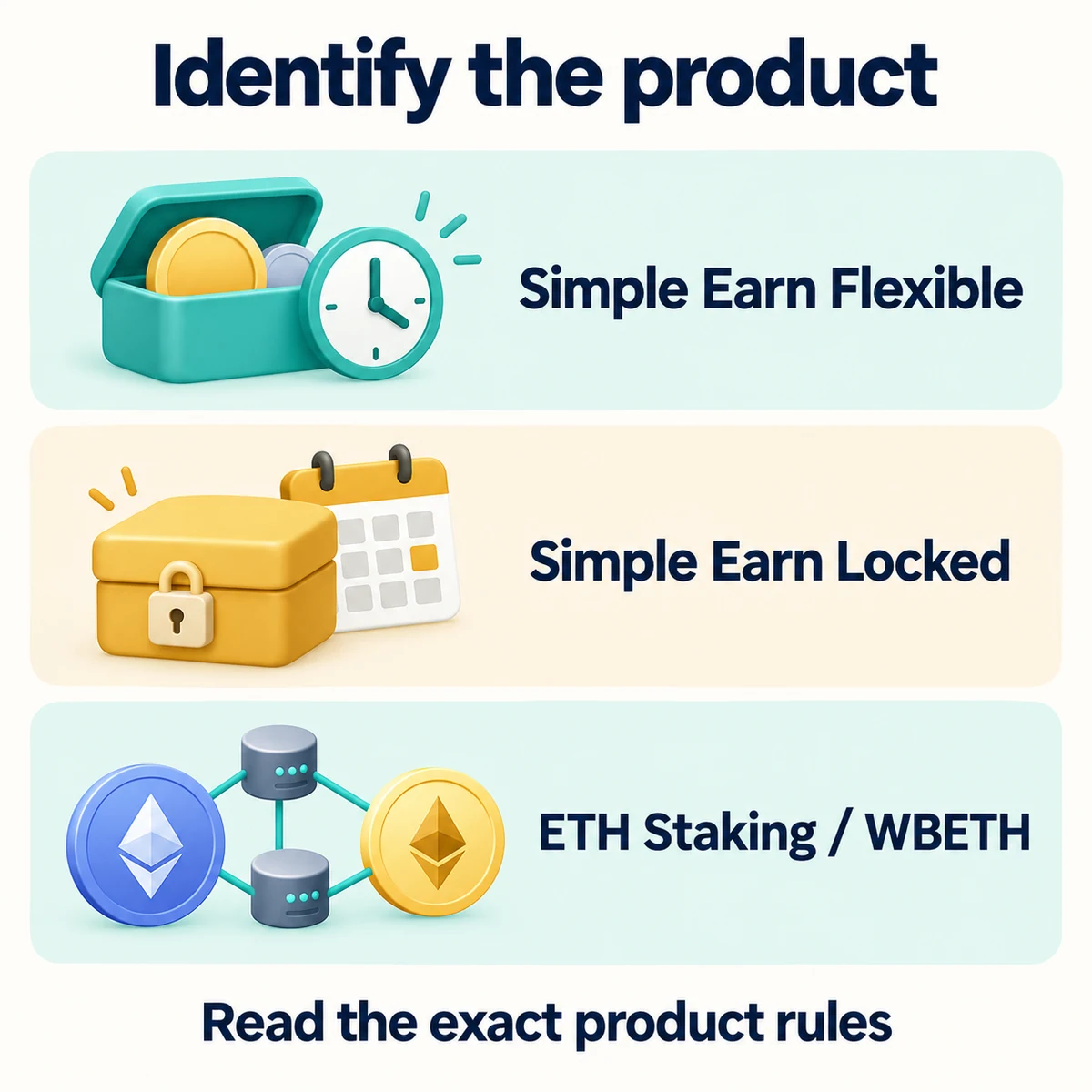
Binance staking is not one universal product with one return or withdrawal rule. Start with the exact product name: Simple Earn Flexible, Simple Earn Locked and ETH Staking/WBETH have different reward records and redemption conditions. A fixed term does not necessarily mean a fixed APR, and a redemption request does not mean the asset has arrived in your Spot Account. This guide explains how to identify the product and read its conditions, not which asset to buy or subscribe to.
Last reviewed: October 13, 2026. Based on the English official sources below; no customer account was accessed or tested. The examples and inspection checklists are Bimence’s educational explanations.
First identify what “staking” means on the screen
In proof-of-stake networks, staking supports validation of the network. A custodial platform can also display several reward products under an Earn menu. The word “staking” in an older article or search query does not establish how a current product uses assets, records rewards or releases funds.
Binance’s Earn overview includes multiple product types. Do not treat Simple Earn and staking as universally separate, mutually exclusive categories; compare the exact offerings instead. This guide focuses on Flexible, Locked and tokenized ETH Staking, not every Earn service. Official Earn overview.
| Product label | What to inspect | Common wrong assumption |
|---|---|---|
| Simple Earn Flexible | Reward components, balance and redemption availability. | “Flexible” guarantees instant access in every situation. |
| Simple Earn Locked | Term, rate type, maturity destination and early-redemption conditions. | A locked period makes the rate fixed. |
| ETH Staking / WBETH | Token holdings, conversion ratio and ETH redemption estimate. | One WBETH must equal one ETH. |
Where rewards appear depends on the product
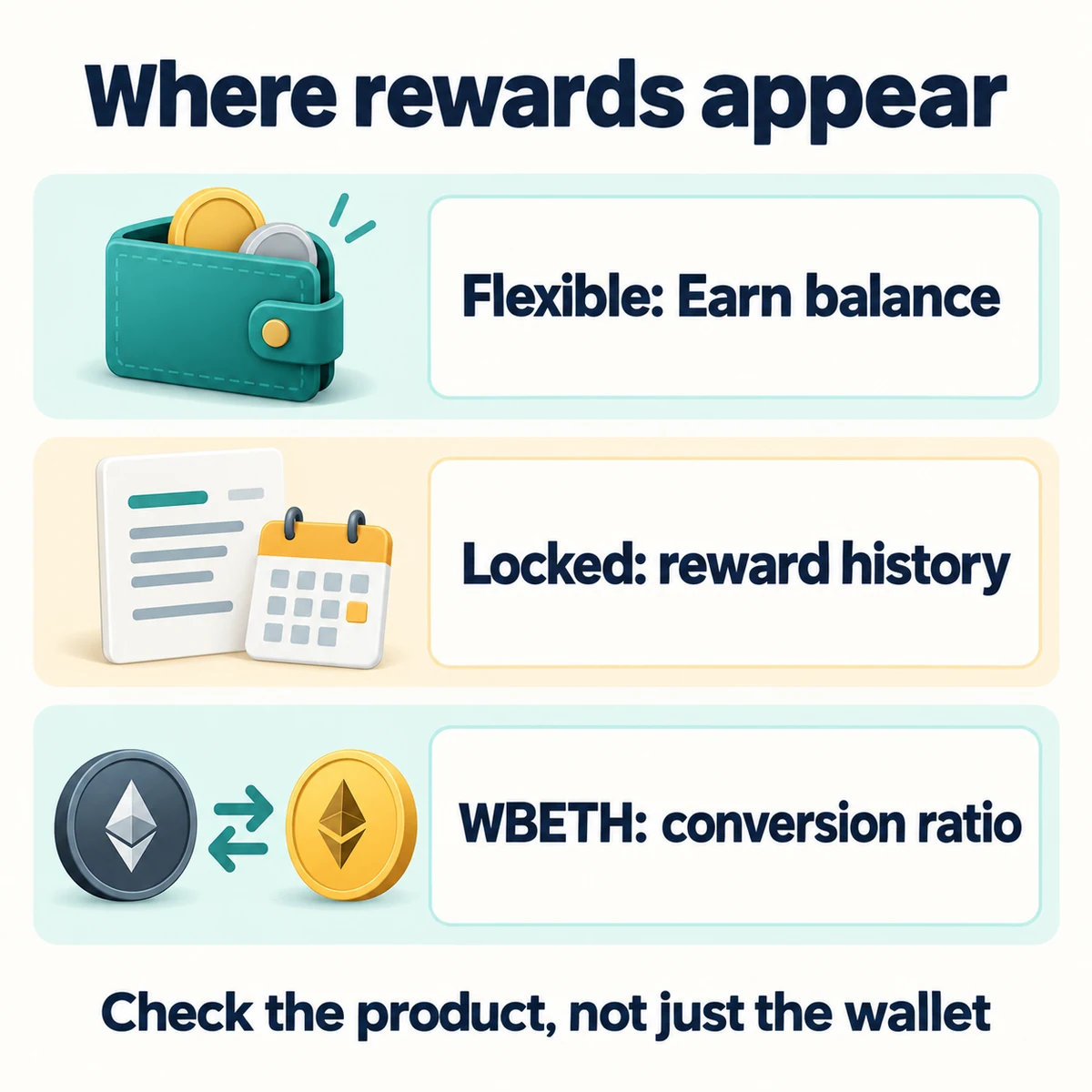
The Flexible guide separates Real-Time APR rewards, accumulated in the Earn balance, from eligible Bonus Tiered APR rewards with separate rules. The latter is not a rate automatically applied to every asset or every account. Binance also describes liquidity use that includes lending; an Earn label alone is not evidence that the balance is directly staked on a blockchain. Official Flexible guide.
For Locked holdings, inspect the reward history and the rules for the particular offer. For WBETH, ETH staking rewards are reflected in the WBETH:ETH conversion ratio rather than a separate daily ETH credit to Spot. A missing Spot credit is therefore not, by itself, proof that WBETH rewards are missing. Official ETH Staking FAQ.
A practical comparison: record the asset, product, quantity, reward asset, accrual period and destination before comparing two balances. A token amount, an estimated fiat value and an annualized percentage are different measurements. Keep them in separate columns rather than treating every displayed increase as the same kind of return.
A fixed term is not a fixed APR
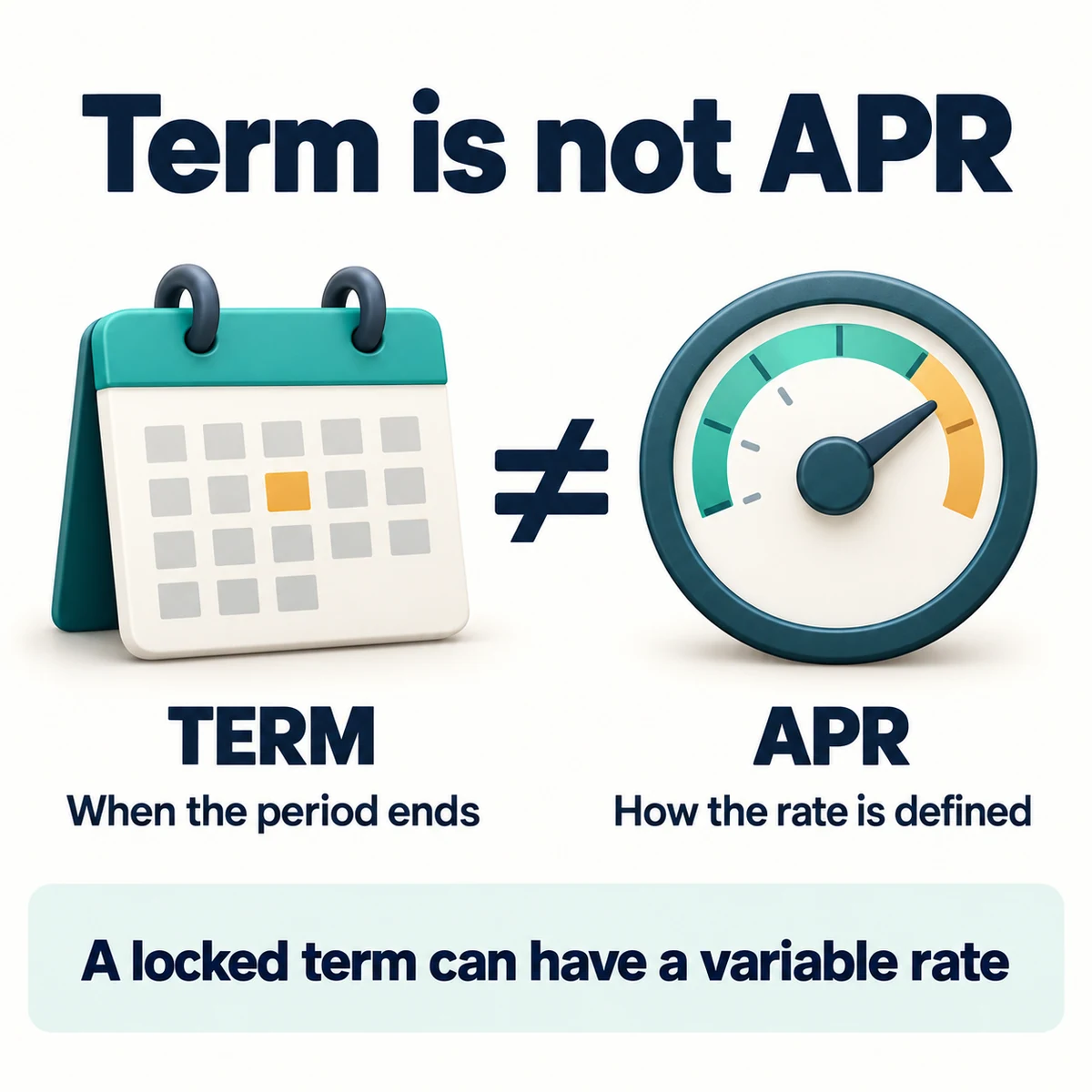
A term describes the period of an offer. APR describes an annualized rate, not a promised gain over that period. Binance’s Locked guide distinguishes variable-rate offers from offers explicitly marked Fixed Rate; the product rules establish which applies. Do not infer a fixed rate solely from a calendar or “Locked” label. Official Locked guide.
Hypothetical arithmetic, not an offered rate: if 100 example tokens had a constant simple APR of 3.65%, a daily estimate would be 100 × 0.0365 ÷ 365 = 0.01 tokens. That arithmetic assumes an unchanged eligible balance and rate, with no compounding, fees, tier caps or rounding. It does not predict a real product’s payout or the tokens’ cash value.
To inspect an offer, write down whether the displayed rate is variable or explicitly fixed, whether only part of the balance receives a particular component, and which asset is used for rewards. If the panel shows an estimate, retain that label in your notes. “Estimated” should not become “guaranteed” when copied into a spreadsheet.
Redemption: request, processing and arrival are different
For Flexible products, daily limits and processing delays can apply. Assets pledged as Flexible Loan collateral cannot be redeemed until the relevant loan is repaid and collateral released. The live account panel matters even when a general description uses “immediate.” Flexible redemption conditions.
For eligible Locked early redemptions, Binance says accrued rewards are forfeited and previously distributed rewards are deducted from the returned principal amount. Some offers cannot be redeemed early. Check the preview’s amount, estimated arrival and reversibility before confirming; do not apply a single waiting time to every product. Locked early-redemption conditions.
Hypothetical reconciliation: a preview returning 99 example tokens after 1 token was already distributed totals 100 tokens across those two records. This explains why a return entry can be smaller than the original subscription; it is not a guarantee of principal, an actual quote or evidence that every discrepancy is a reward adjustment. Check fees and other movements separately.
For ETH Staking, inspect the WBETH:ETH ratio, permitted amount and estimated ETH distribution date on the redemption screen. The FAQ says submitted ETH redemption requests cannot be canceled. Selling WBETH on a market is a different operation from redeeming it for ETH; the market price can differ from the product’s conversion ratio. ETH redemption FAQ; ETH Staking product explanation.
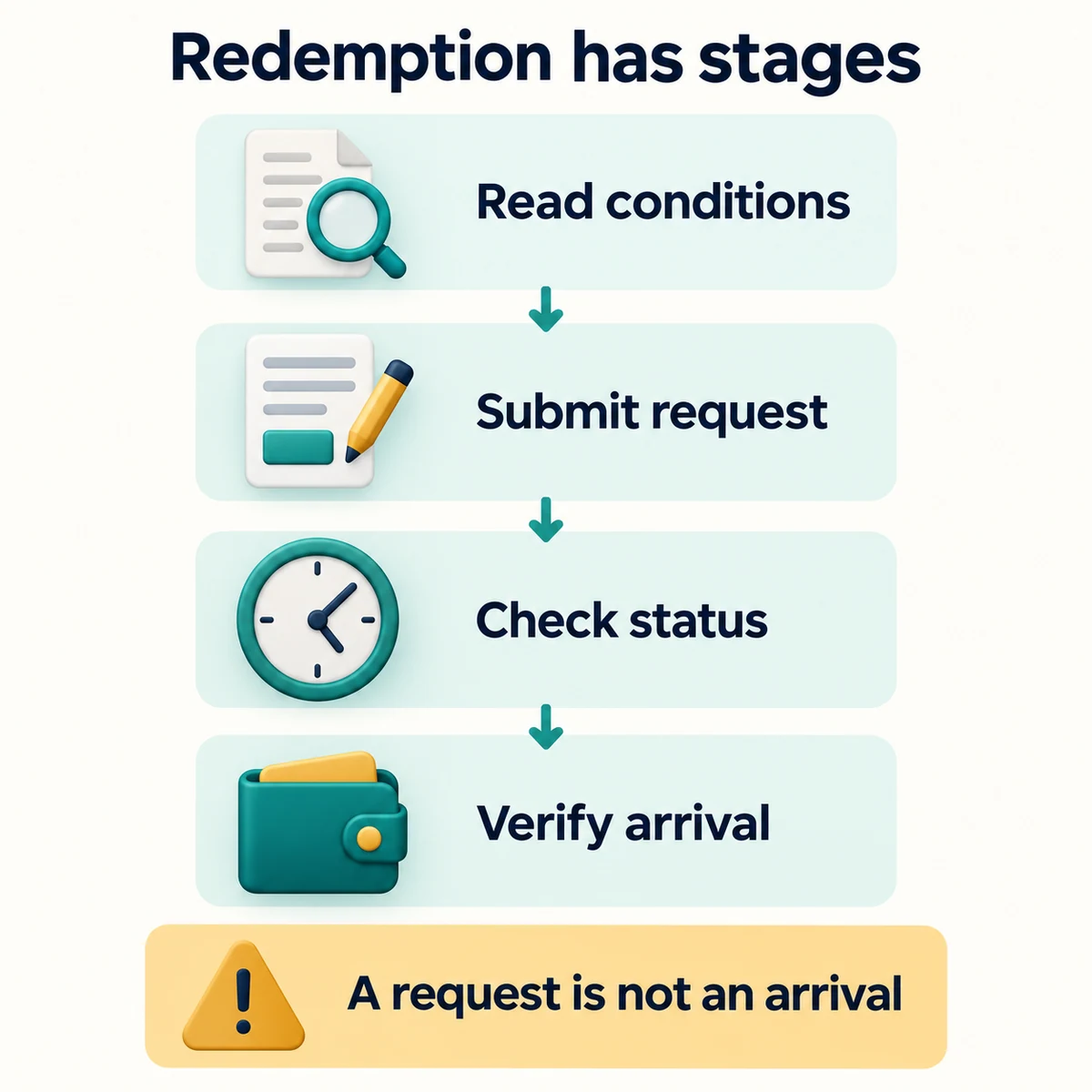
Where to check the conditions in your Binance account
- Open the specific holding. Start in Earn and select the product, not just the asset’s total portfolio value. On the app, the official Flexible guide uses Assets → Earn; labels can vary by interface.
- Read the product rules. Note the full name, rate type, eligible amount, reward destination and region/account conditions. Product visibility does not establish availability for another person.
- Inspect renewal settings. Check Auto-Subscribe and the destination at maturity. A completed term does not always mean an asset will remain available in Spot; the chosen settings can direct it elsewhere.
- Inspect the redemption preview without submitting it. Record the asset and net amount to be returned, any reward adjustment, quota, estimated date and whether the request is reversible.
- If a request already exists, check it first. Compare its status with Earn history and the receiving wallet. Avoid duplicate requests simply because a balance has not changed immediately.
These inspection steps are Bimence’s checklist, not a claim of hands-on access to a live account or a suggestion to subscribe. If a status and balance disagree, retain the relevant reference and ask authenticated support about that specific product. Never provide a password, security code or API secret to someone offering to “unlock” a redemption.
Costs, records and risks to keep separate
A displayed reward rate does not explain every possible cost. Look for the product’s reward commission and redemption adjustments separately from trading or external withdrawal charges. Our Binance fees guide covers those cost categories; the deposit and withdrawal guide explains the separate network-transfer checks.
The ETH Staking page says its APR is variable and identifies validator/slashing risk to the underlying stake. Flexible documentation identifies borrower, liquidity and extreme-event risks, including possible loss. Neither a product label nor a single FAQ sentence is a universal principal guarantee. Review the current applicable terms and risk notice rather than assuming every product has identical protection. ETH Staking risks; Flexible risks.
Keep the subscription, reward and redemption records identifiable. Our transaction-history export guide explains file-scope and date checks; a Spot trade file alone should not be assumed to capture all Earn activity. For account controls, see the security guide.
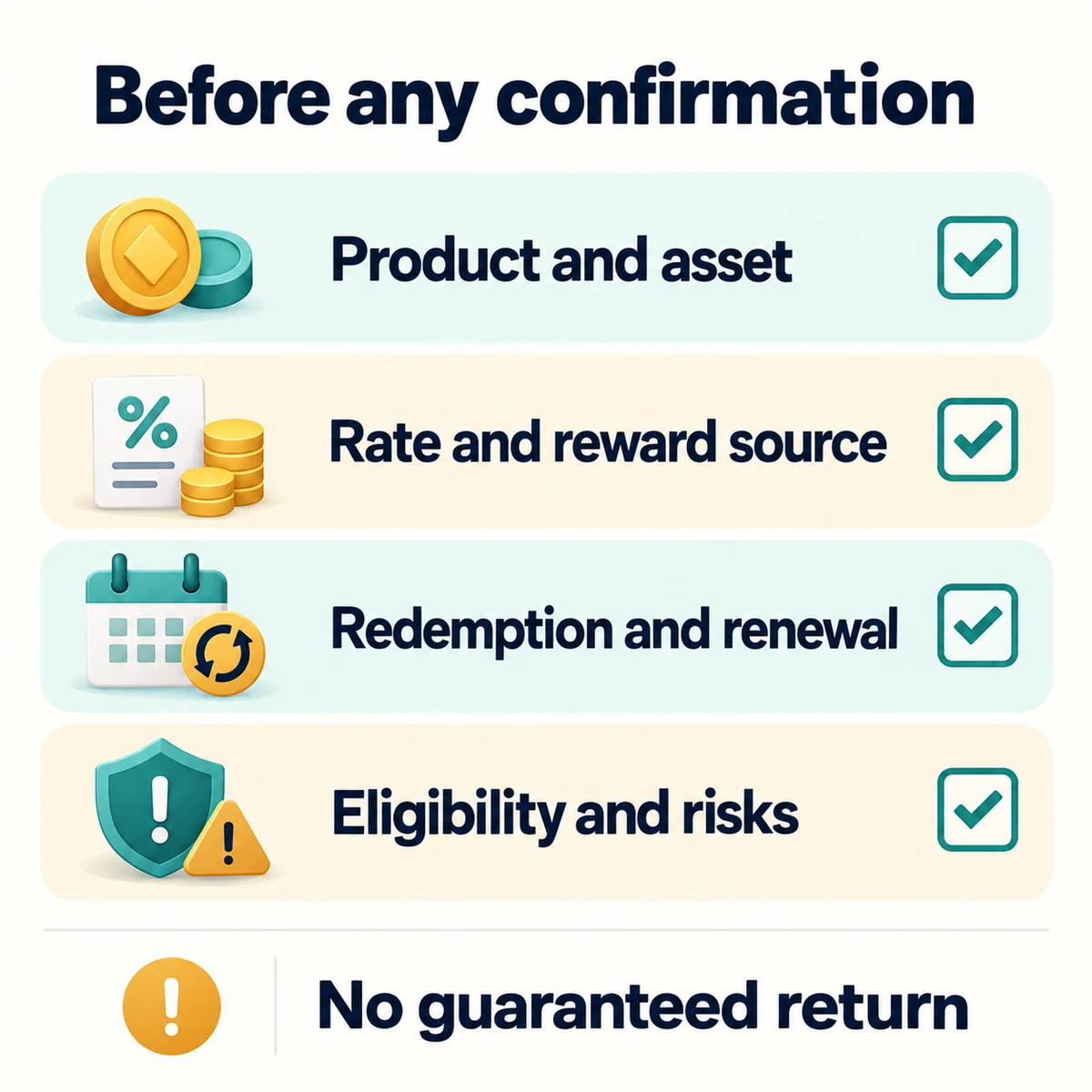
Frequently asked questions
Is every Binance Earn balance on-chain staking?
No. Identify the exact offering and its stated use of assets. A broad Earn menu, a search keyword or a legacy product name is not enough to establish an on-chain staking relationship.
Why does a completed Locked term not leave funds in Spot?
Inspect the maturity destination, Auto-Subscribe setting and resulting history. Distinguish a renewal or transfer into another product from a missing redemption. The product rules and actual records determine what happened.
Can I treat WBETH as the same quantity of ETH?
No. Check the applicable conversion ratio for redemption, and distinguish it from a market quotation. Preserve the WBETH quantity and the resulting ETH amount as separate fields when reconciling the transaction.
Official sources and review scope
English sources checked on October 13, 2026:
- Binance Earn overview — product scope and terminology.
- Simple Earn Flexible guide — rewards, redemption and risks.
- Simple Earn Locked guide — rate types, maturity and early redemption.
- ETH Staking FAQ — WBETH reward records and ETH redemption.
- ETH Staking product page — conversion versus market price, variable APR and risks.
Account conditions and product availability can differ by region and service. This guide is not a statement that an offer is available to everyone. Product-specific account rules and applicable legal terms require separate review before a decision. Bimence’s examples are hypothetical; diagrams are generated educational illustrations, not Binance screens. See our About & Editorial Policy.
Affiliate disclosure: Bimence may earn commissions from eligible activity through affiliate links elsewhere on this site. Reading this guide does not require a referral code or a new account. See the Affiliate Disclosure.
Risk disclosure: Cryptoasset values can fall, access can be restricted, and rewards or redemption timing are not universally guaranteed. This is general education, not investment, financial, legal or tax advice. See the Risk Disclosure.