
To read Binance Futures as a beginner, first confirm whether the environment is demo or live, identify the contract and margin mode, then separate an order from its executions and any resulting position. Demo Trading uses virtual assets, but its availability is conditional and its results do not establish what would happen with real money. This guide explains screen labels and verification steps; it does not select a contract, leverage, entry price or trade for the reader.
Last reviewed: October 18, 2026. Official English-language Binance materials were checked on this date. Bimence did not access or test a customer trading account. The ten illustrations and hypothetical examples are editorial explanations, not Binance screenshots or evidence of a real account.
1. Eligibility is separate from account creation
Binance’s current Demo Trading FAQ says a Binance account is required and that eligible users can access the demo without completed KYC or a live Futures account. It also limits availability to certain countries and regions. A demo menu, account registration or completed identity check is not evidence that live derivatives are permitted for a particular person. Official demo eligibility and access FAQ.
Check the account notice, current product terms and rules for the place of residence before relying on a feature. Language is not residence. If access is restricted, do not use a VPN, false location, someone else’s account or an unofficial app to work around it. Regulatory treatment can change: South Korea’s Financial Services Commission published an October 13, 2026 notice on blocking domestic access to unregistered operators’ websites; that notice is not an authorization for any exchange or product. FSC notice.
The separate Binance account-creation and KYC guide explains registration checks. It does not establish derivatives permission. This article contains no registration button, referral offer or instruction to fund an account. Binance’s affiliate restricted-countries guide also distinguishes marketing restrictions from ordinary product explanations.
2. Demo versus live: verify the environment, not a familiar balance
Demo tokens have no economic or monetary value. A virtual balance reset is not compensation for a live loss, and a demo result is not a reliable indicator of future live performance. The demo can differ from live trading in features, data and execution. Binance Demo Trading Terms.
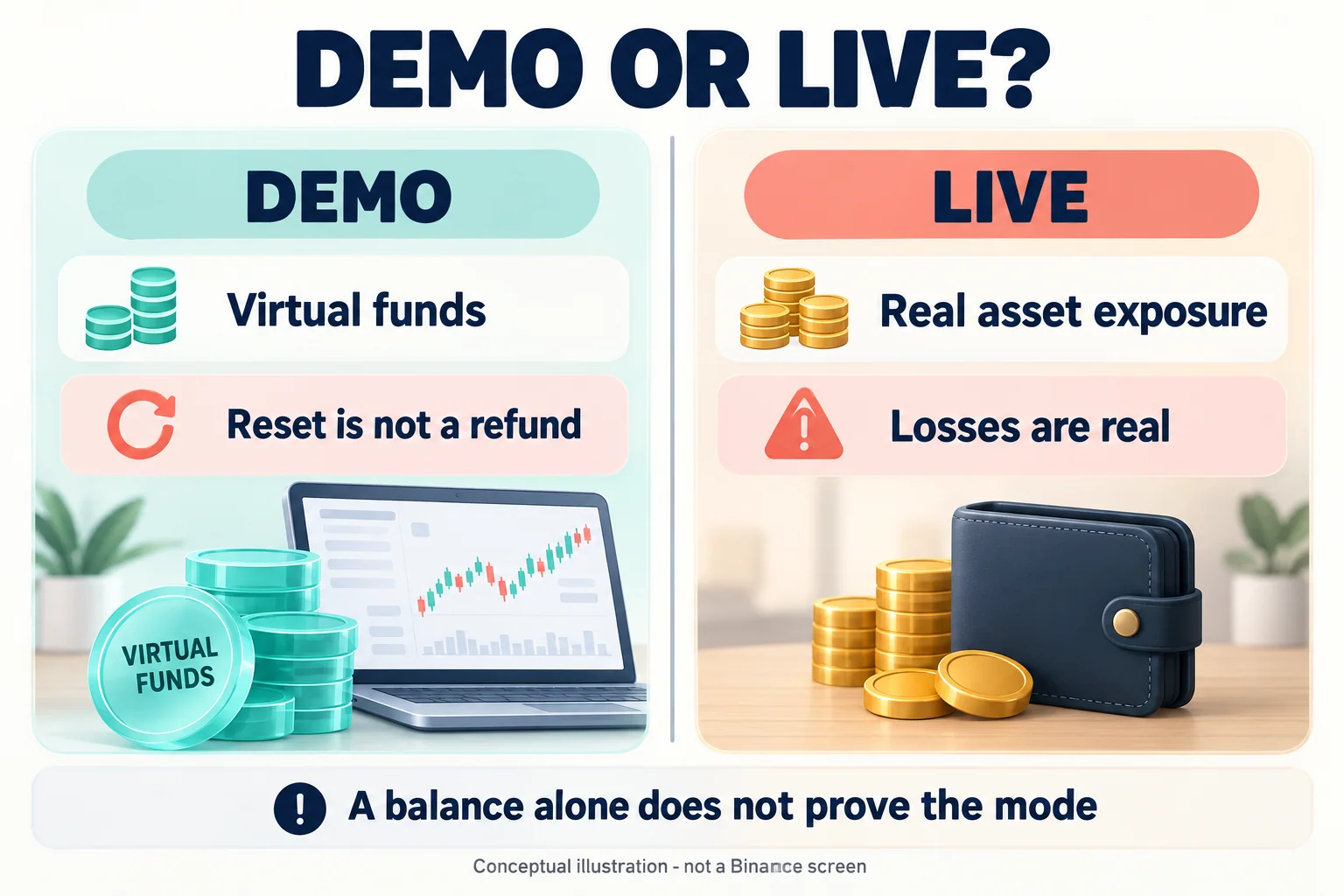
Bimence environment check: begin from the independently opened official website or app, follow its documented demo entry, then read the explicit environment label and surrounding navigation. The official web instructions show a Back to Live control in the demo. Do not infer that the absence of that control proves live mode; layouts can differ. If the environment remains uncertain, stop before submitting anything.
| Check | What it establishes | What it does not establish |
|---|---|---|
| Explicit demo label and official navigation | The environment identified by that interface. | Eligibility for live Futures. |
| Balance and account history | Which account and records are being displayed. | A starting amount that proves demo mode. |
| Demo result or reset | A simulated record or virtual-balance change. | Withdrawable money, a refund or expected live performance. |
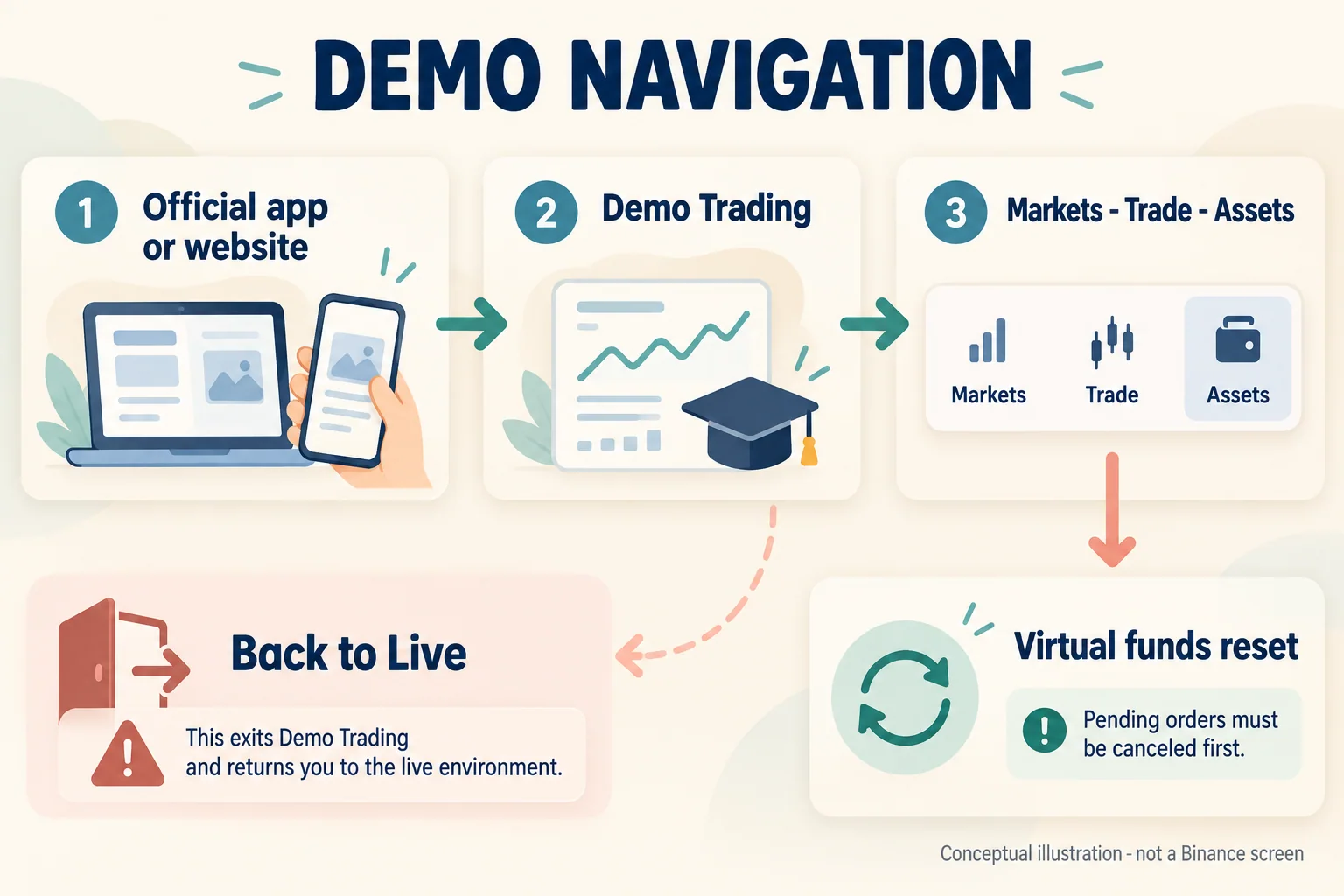
Current demo entry and reset locations
The official FAQ places the web entry at Trade → Demo Trading, with a Futures entry under More → Demo Trading. On the app it describes More → Demo Trading under Common Function, or the additional menu on Spot/Futures. Virtual funds are reset under Assets for the selected demo account; pending orders must first be canceled. This is a location reference, not a request to place an order. No fixed starting balance or legacy faucet amount is assumed here.
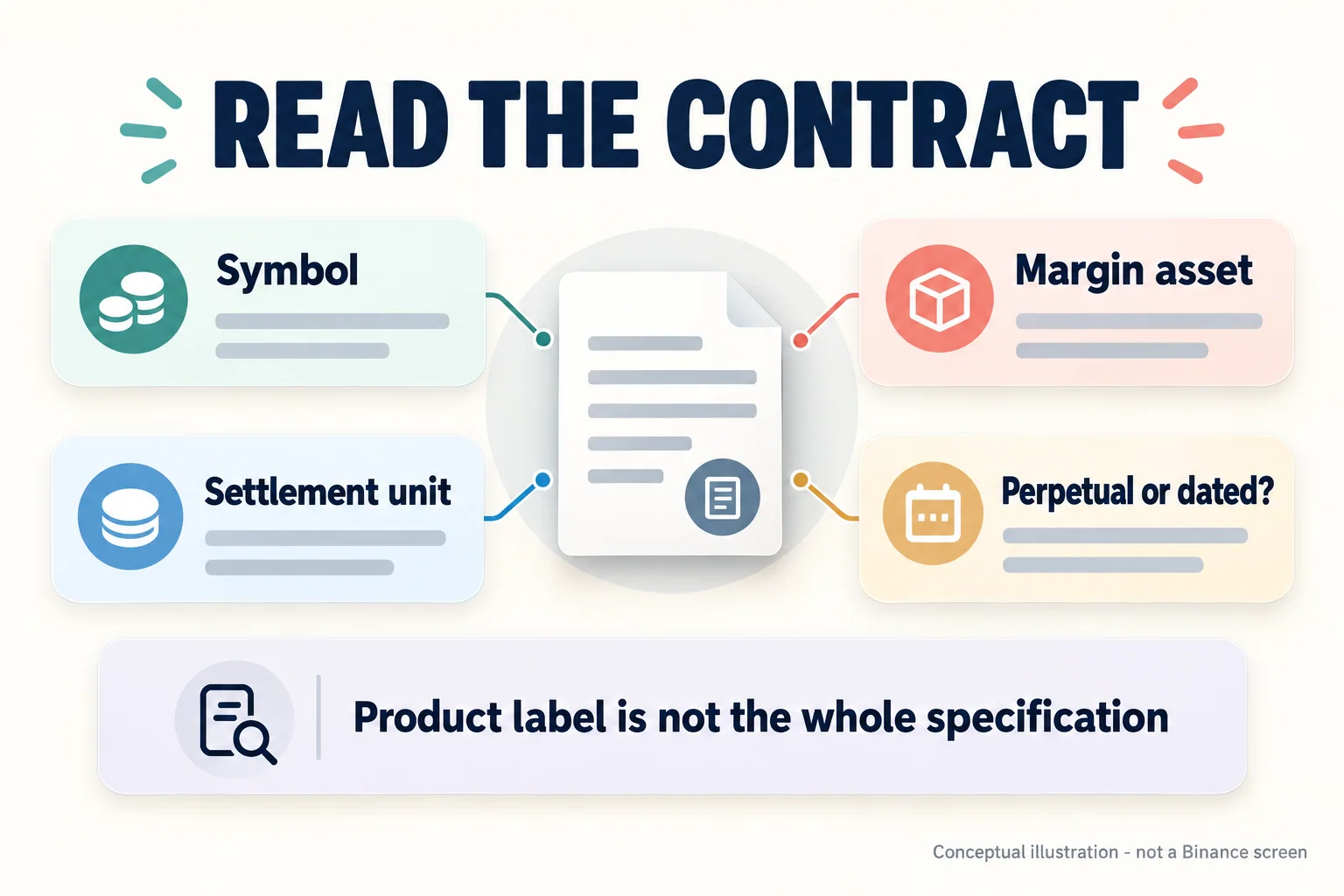
3. Read the contract, collateral and settlement unit separately
A product family name is not a complete contract specification. Before interpreting any number, note the symbol, whether the contract is perpetual or dated, the quantity unit, the margin asset and the unit in which profit, loss and fees are recorded. A coin quantity and a stablecoin amount are not interchangeable.
| Label | Question to answer | Common confusion |
|---|---|---|
| Symbol and contract type | Which exact contract and expiry convention is shown? | Assuming two contracts on the same asset have identical rules. |
| Margin asset | What collateral is eligible in this account mode? | Assuming every wallet holding can support this position. |
| Quantity and settlement | What unit is entered, and what unit records the outcome? | Reading a value field as a coin quantity. |
Binance publishes separate USDⓈ-M leverage and margin guidance and coin-margined contract guidance. Do not carry a linear USDT example into a coin-settled calculation. The ordinary app and Spot screen guide covers a different product context.
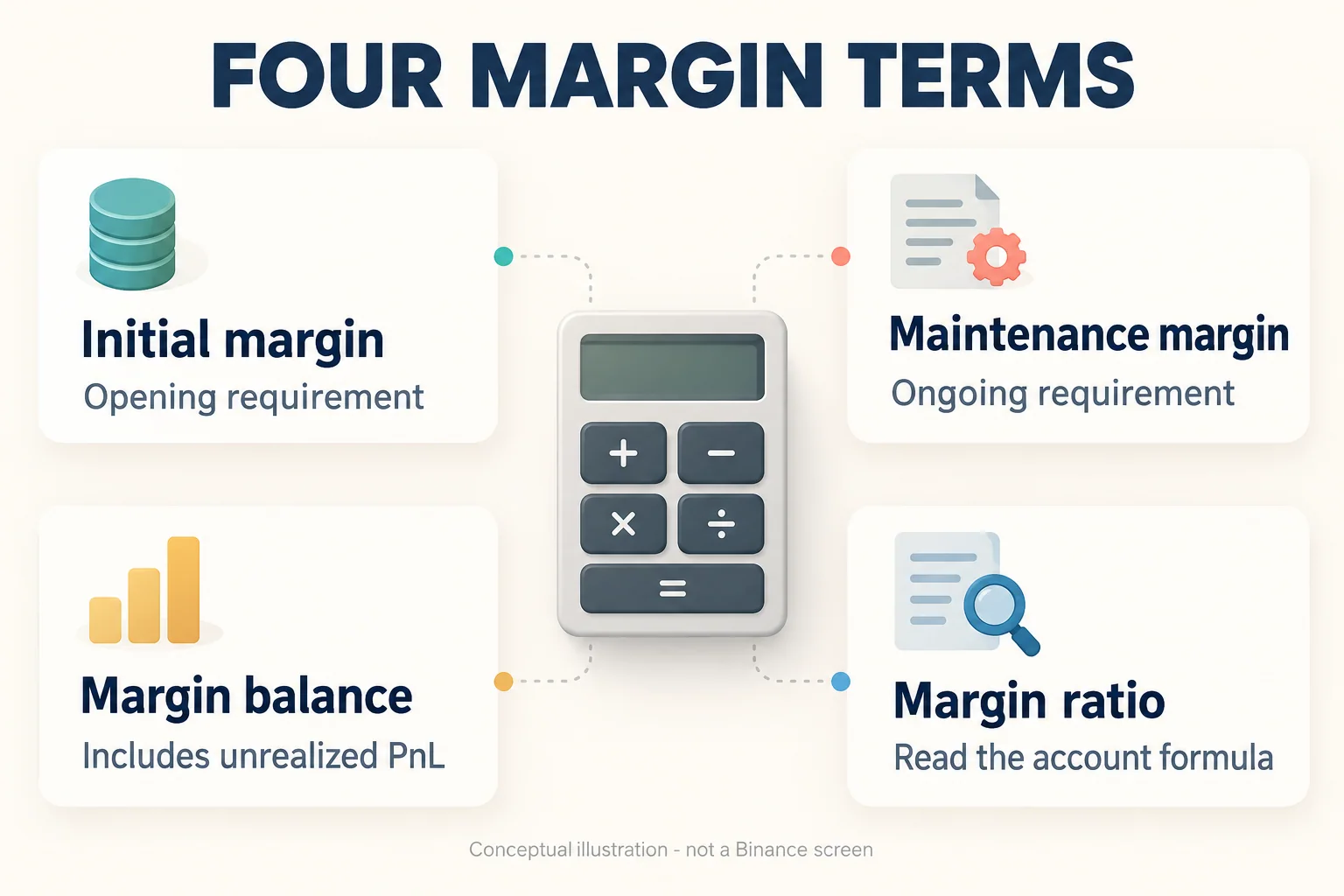
4. Four margin terms that answer different questions
| Term | Meaning in this guide |
|---|---|
| Initial margin | The opening-margin requirement for the position. It is not necessarily the full order cost or reservation. |
| Maintenance margin | The ongoing collateral requirement, determined by the relevant position tier and contract rules. |
| Margin balance | The applicable margin balance including unrealized profit or loss, subject to the account’s calculation method. |
| Margin ratio | A risk ratio whose formula and scope must match the selected account and mode. |
For the USDⓈ-M tier model described by Binance, maintenance margin is position notional × maintenance margin rate − maintenance amount. The rate and maintenance amount come from the current bracket, not a universal fixed percentage. For an unchanged notional and bracket, choosing a different leverage does not itself change that maintenance requirement. Official tier and maintenance-margin explanation.
Binance’s classic Futures liquidation explanation expresses margin ratio as maintenance margin ÷ margin balance; when expressed as a percentage, multiply by 100. It describes liquidation around the 100% threshold and uses Mark Price rather than simply the last trade. This is not a universal formula for every portfolio or unified-account risk metric. Official Futures liquidation protocol.
A lower displayed ratio is not a safety guarantee. Estimated liquidation values can change with collateral, other positions, funding, fees, tier changes and market conditions. A screenshot or a rough “one divided by leverage” estimate is not a dependable liquidation price.
5. What leverage changes when the position size stays fixed
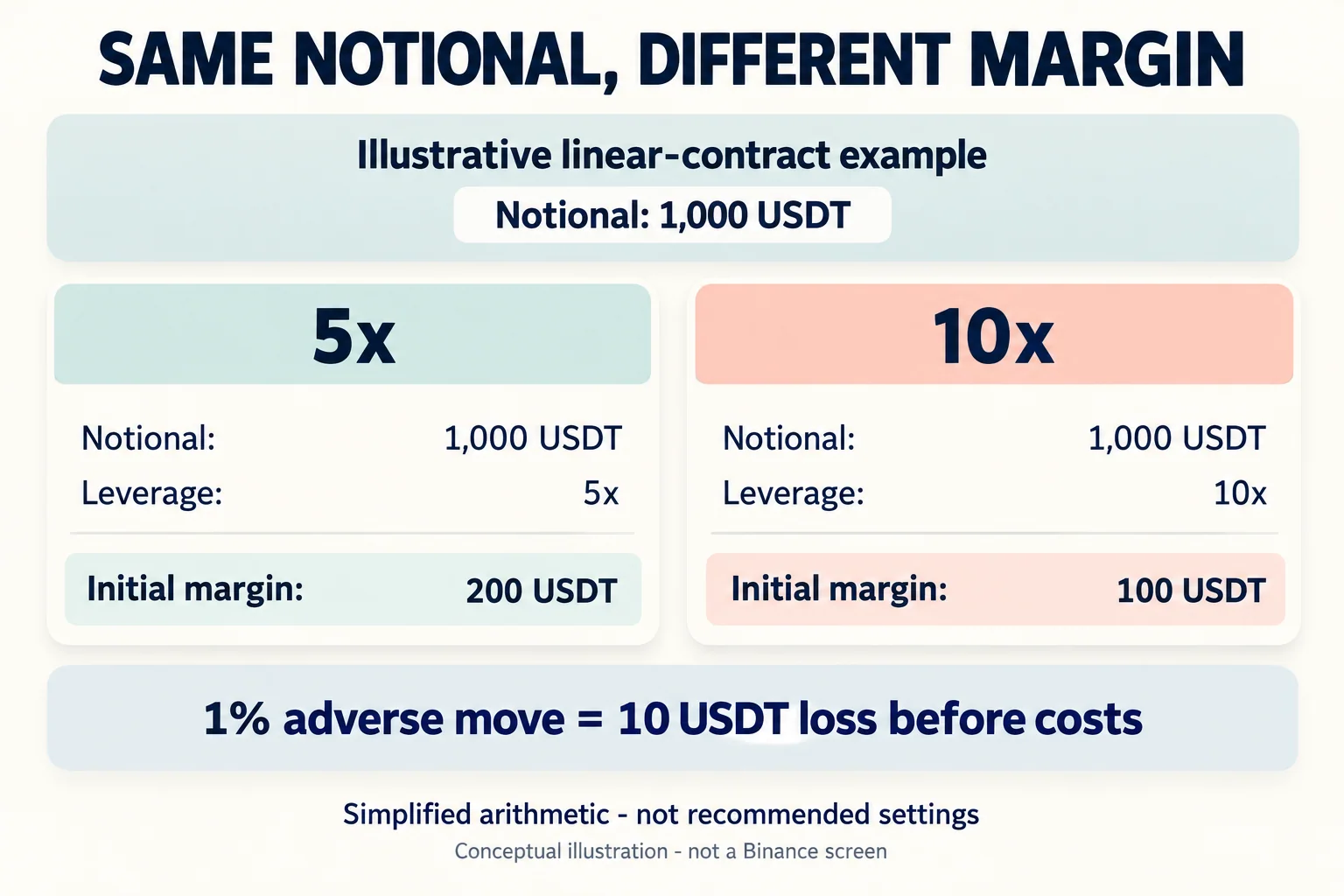
Hypothetical linear-contract arithmetic: assume the same position quantity at a reference price giving a 1,000 USDT notional. Ignore fees, funding, other reservations and liquidation. A simplified initial-margin calculation is notional ÷ leverage. Actual order cost may also include an opening loss or other applicable amounts; Binance explains those separately in its margin-requirement guide.
| Illustrative leverage | Same reference notional | Simplified initial margin |
|---|---|---|
| 5× | 1,000 USDT | 200 USDT |
| 10× | 1,000 USDT | 100 USDT |
For that fixed quantity, a 1% adverse change from the reference price gives a 10 USDT loss before costs in either example. The leverage setting changed the simplified opening margin, not that quantity’s price sensitivity. If quantity is increased instead, exposure changes too. Neither setting is recommended, and this example deliberately calculates no liquidation price or “safe” market move.
6. Cross and isolated describe collateral allocation
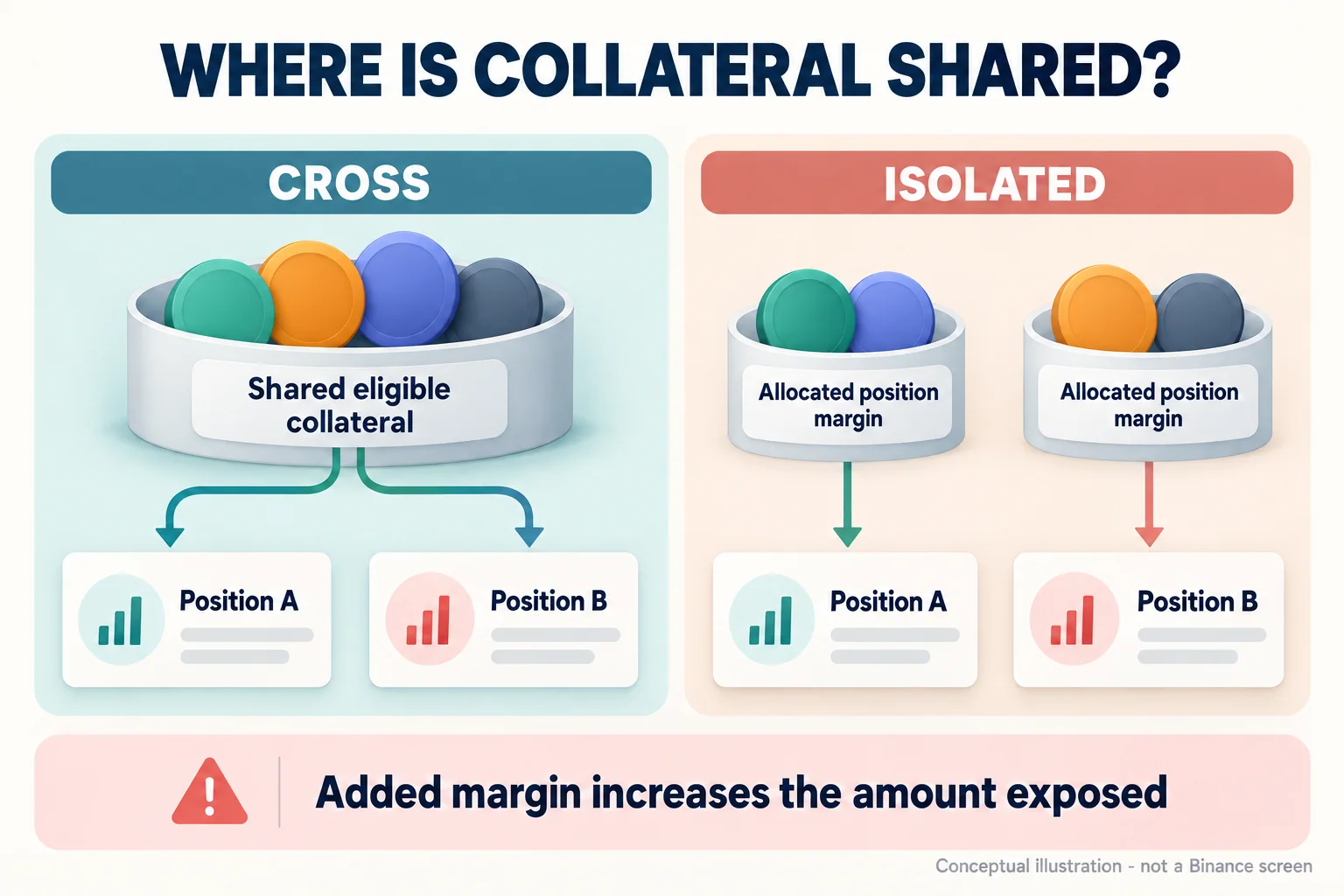
In an ordinary cross-margin arrangement, eligible collateral is shared across the positions in that pool. Isolated margin allocates collateral to a particular position rather than automatically treating every account holding as that position’s collateral. Binance’s isolated-margin explanation describes that allocation distinction; its Futures margin-adjustment guide explains adjustments to the allocated amount.
The boundary to preserve: isolated does not mean the original opening margin is a permanent account-wide loss cap. Later allocations increase the amount exposed, other positions have their own risks, and any additional-funding feature must be read under its actual account rules. Cross does not mean all assets everywhere in Binance are automatically pledged. Verify the eligible pool and account mode; neither label establishes that funds are safe.
7. Mark Price, last price and a stop trigger are separate references
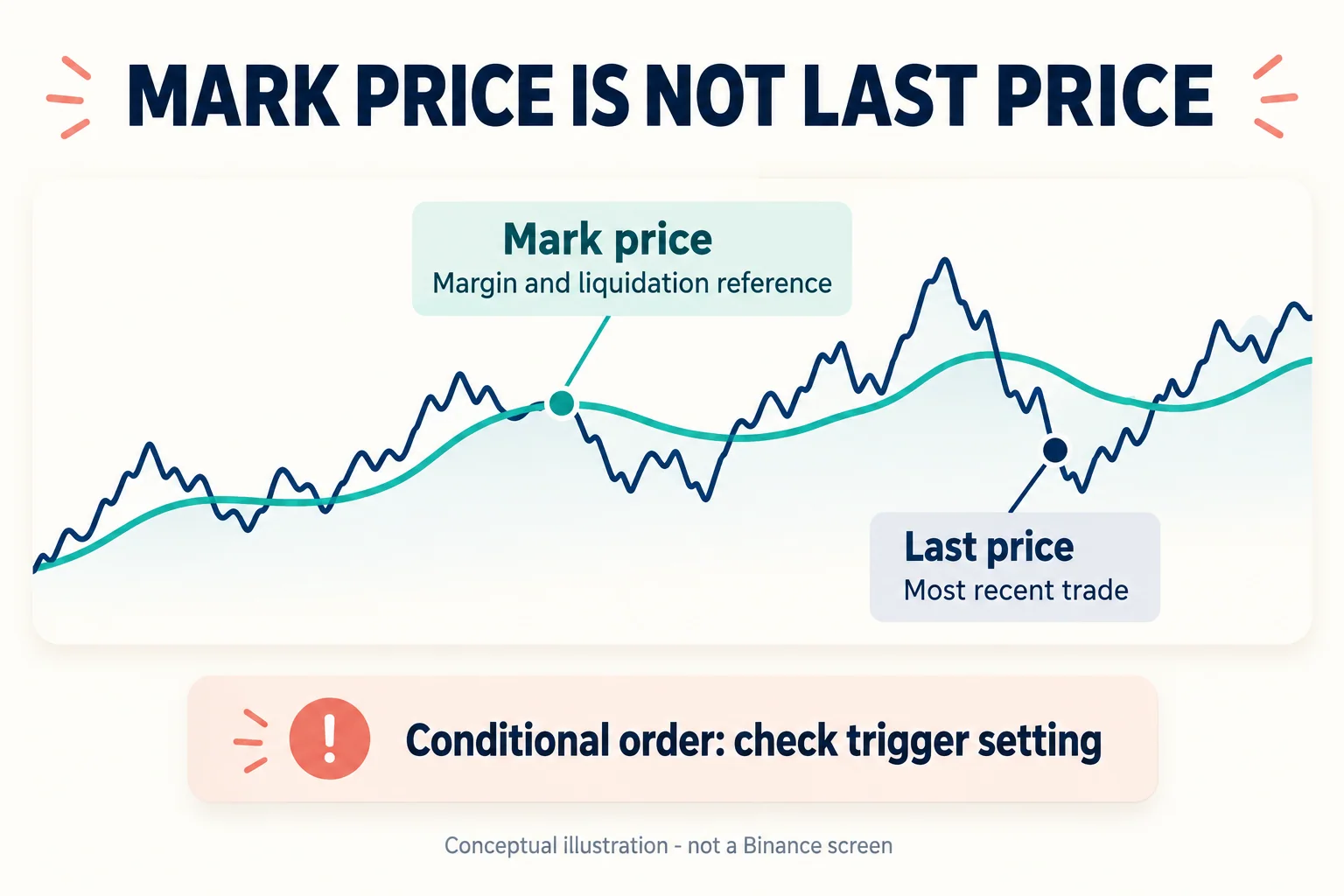
The last price records the most recent trade. Mark Price is a calculated reference used for margin and liquidation assessment; it is not necessarily the price at which an order can execute. Binance Academy’s Mark Price definition distinguishes the two. A chart displaying one reference does not prove that another risk calculation uses it.
A conditional order may use a selected trigger reference. Read that setting independently of the chart and the estimated liquidation price. A trigger is a condition for an order, not a guaranteed execution price or protection from liquidation; a triggered limit order can remain unfilled. Official Futures order-type explanations.
8. An accepted order is not the same thing as a position
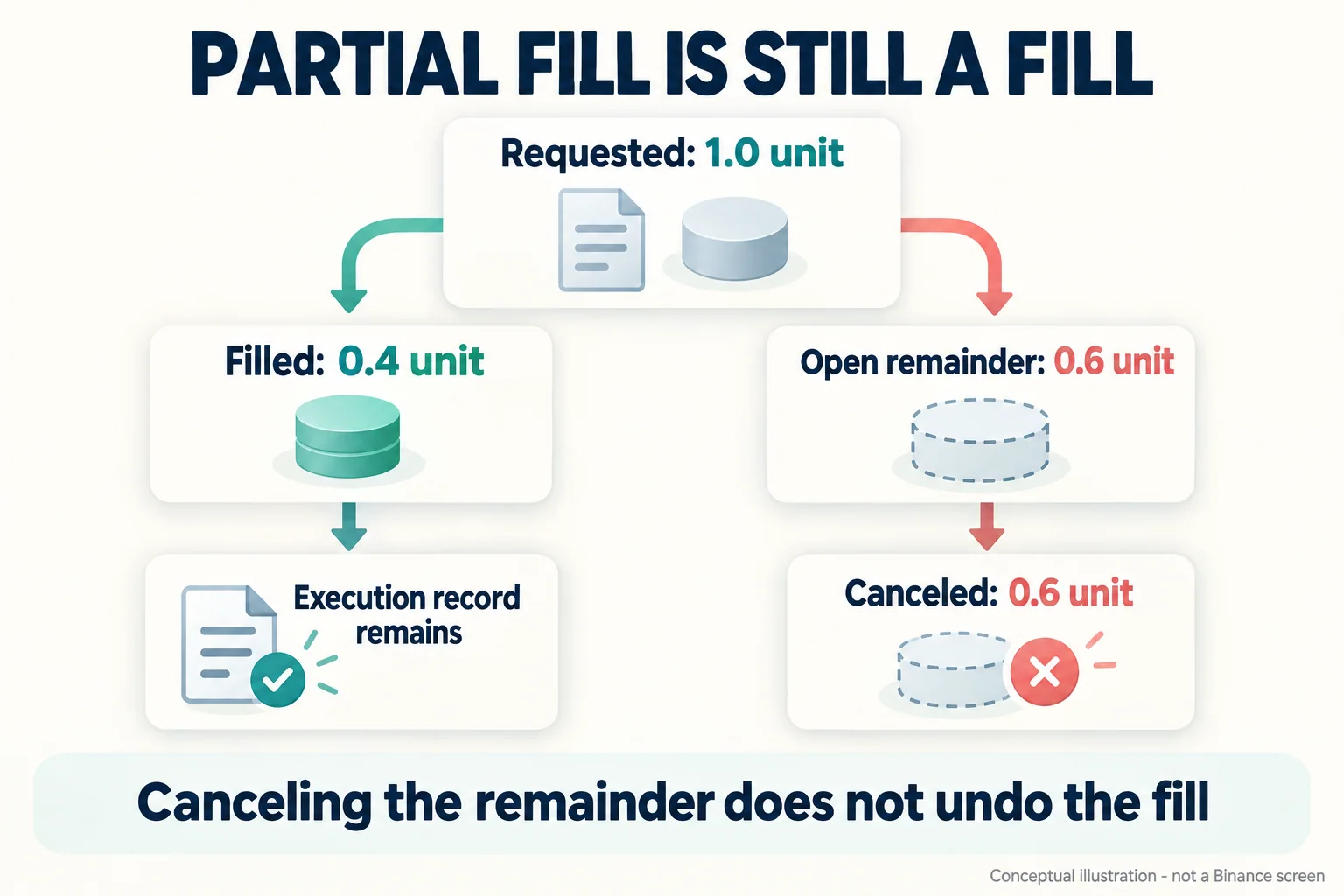
An order is an instruction; an execution is a completed fill; a position is the exposure remaining after relevant fills. A fill can open, reduce or close exposure depending on side, size and position mode. A canceled order can already contain executed quantity.
| Record | What to inspect | What not to assume |
|---|---|---|
| Open Orders | Remaining quantity, status and any conditional orders shown separately. | That every outstanding order has zero fills. |
| Order History | Original quantity, executed quantity and final status. | That canceled means nothing happened. |
| Positions | Current size, side and applicable margin fields. | That a past fill must leave a position open now. |
| Trade and income records | Individual fills, commissions and separate funding entries. | That one order row is the complete net-profit ledger. |
Hypothetical reconciliation: an opening order from a flat one-way position requests 1.0 unit; 0.4 fills and 0.6 remains open. Canceling the remaining 0.6 does not erase the 0.4 execution. If there were prior positions or other fills, the current position must be reconciled separately. This is an explanation of records, not an instruction to submit a test trade.
Binance’s USDⓈ-M order documentation distinguishes acknowledgment, execution information and position-side parameters. This article reads those definitions only; it does not require an API key or automated order submission. The transaction-history export guide addresses obtaining records rather than duplicating this screen-reading process.
9. Position mode changes what a side label means
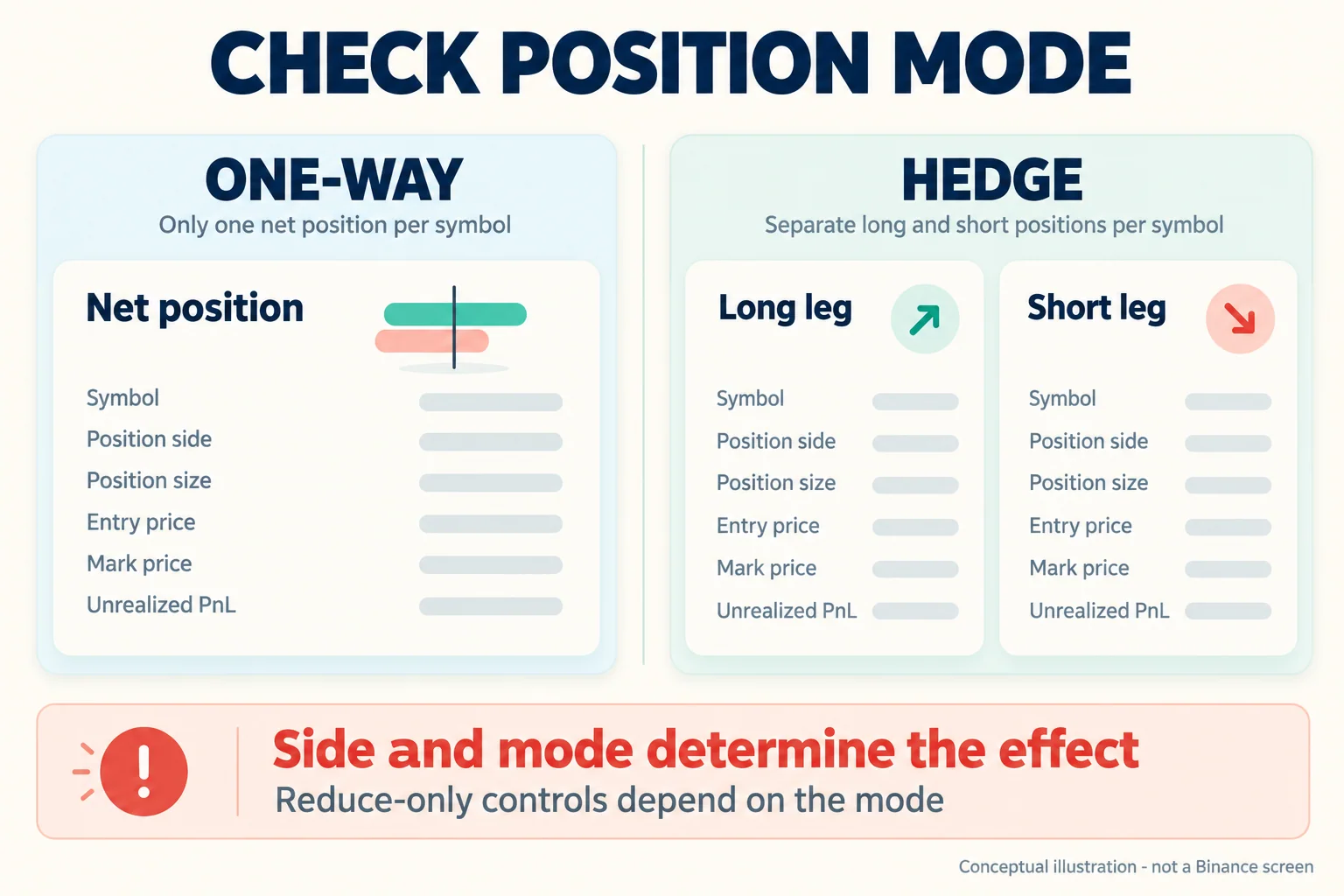
One-way mode uses a net position for the relevant contract. Hedge mode distinguishes long and short position sides. A Buy or Sell label alone is therefore insufficient to infer whether an instruction opens, reduces or closes exposure. Check the mode, position side, outstanding orders and executed quantity together.
Reduce-only is intended to prevent an applicable order from increasing exposure, but it is not a universal checkbox across every mode or order route. In the current USDⓈ-M API definition, the reduceOnly parameter cannot be sent in Hedge Mode. Do not copy a one-way closing instruction into a hedge-side workflow or assume a closing control guarantees a fill. The cited order documentation supplies the mode-specific conditions.
For common types, a limit order sets a price boundary rather than guaranteeing execution; a market order seeks execution against available liquidity and can suffer slippage. Post-only concerns maker behavior. Time-in-force options concern how a remainder is handled. They do not make a position suitable or remove its risk. Product and demo feature support must be checked separately.
10. Check fees, funding and income records separately
A trading commission is based on the executed notional and applicable rate, not simply the opening margin. Maker/taker treatment depends on execution, and an opening and a closing fill can each incur commission. Verify the account’s actual rate, product and any eligible setting rather than carrying a fixed percentage or BNB discount from a tutorial. Official Futures fee calculations.
Perpetual funding is a separate transfer between opposing position holders under the contract’s funding conditions. The sign, position direction, notional and specified funding time matter. Intervals can differ. Binance also notes a possible 15-second deviation in the actual funding transaction time, so “close one second before the countdown ends” is not a reliable promise of avoiding a payment. Official funding-rate explanation.
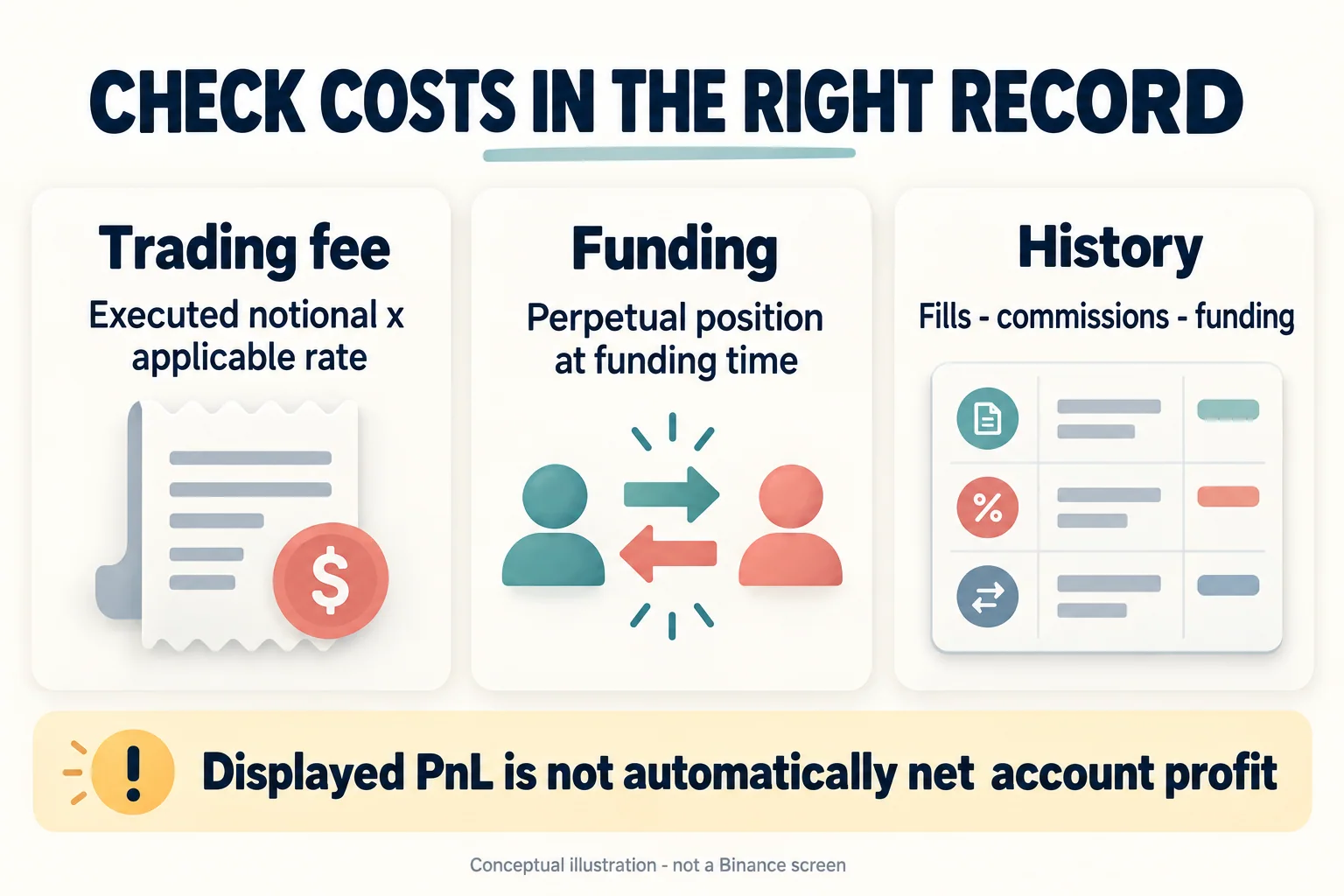
For detailed cost categories, use the Futures fees and funding guide and the broader Binance fees guide. Demo cost displays are not proof that the same amounts or execution would occur live.
11. A reading checklist, without a live-trading instruction
- Environment: identify the explicit demo/live state using the official navigation. If uncertain, stop.
- Product and units: record the contract, margin asset, quantity unit and settlement convention.
- Account scope: identify cross/isolated and position mode. Do not assume a portfolio-wide formula from a classic example.
- Risk fields: distinguish opening margin, ongoing margin, Mark Price and any displayed liquidation estimate.
- Records: reconcile requested, filled and remaining quantity with the current position. Check conditional orders separately where provided.
- Costs: inspect applicable fee information and the contract’s funding conditions rather than estimating from opening margin.
- Restrictions and support: retain the non-sensitive error text and use official support if labels or eligibility remain unclear. Never share passwords, OTPs, private keys or recovery secrets.
There is no requirement to deposit or submit an order to read these labels. A completed checklist is not a recommendation or authorization to move to live trading. The account-security guide covers separate access safeguards.
Common questions
Can a demo result be withdrawn or used to predict live returns?
No. Demo assets have no monetary value, and simulated performance is not a reliable prediction of future live performance. A virtual reset does not reverse any live activity.
Why is there an order but no position?
The order may be unfilled, rejected, canceled or expired, or a fill may have reduced existing exposure. Inspect its executed quantity and current position instead of repeating an ambiguous instruction.
Does a higher leverage setting always increase the currency loss?
Not when the position quantity and price change are held fixed in the simplified linear example. It changes the opening-margin requirement. Increasing quantity changes exposure; real maintenance and liquidation conditions still apply.
Does isolated margin guarantee that the rest of the account is safe?
No. Its allocation boundary is specific to the position and mode. Later margin allocations and other positions matter, and no collateral label removes market, platform or cybersecurity risk.
Official sources and editorial boundaries
Reviewed October 18, 2026. The linked Help Center, Academy, developer and legal materials support different parts of this explanation. An English URL or regional locale path is not evidence of product eligibility in that place. Help Center guidance is educational; the current account terms, contract specifications and applicable law control. No customer trade was performed for this article.
- Demo access, navigation and reset conditions; Demo Trading Terms.
- USDⓈ-M leverage and maintenance tiers; margin requirements.
- Futures liquidation protocol; Mark Price definition; isolated collateral definition.
- Futures order types; USDⓈ-M order and position-side definitions.
- Futures fee calculations; funding conditions.
Risk and independence: derivatives can cause rapid, substantial losses and liquidation. This page is general education, not investment, legal, tax or individualized account advice. Bimence is independent of Binance and may receive affiliate commissions through links elsewhere on the site; this page does not promise a referral benefit. Read the Risk Disclosure, Affiliate Disclosure and About & Editorial Policy.